Home / Car Insurance / Articles / Motor Insurance Exclusions and Inclusions
Motor Insurance Exclusions and Inclusions
Nikhila PSSept 8, 2026
Share Post
Motor insurance inclusions and exclusions determine exactly what your policy will cover and what it will not before purchasing an insurance plan. Inclusions specify the financial coverage you get for vehicle accidents, theft, third-party liabilities, and natural disasters. Exclusions are conditions or circumstances for which the insurer will not pay the claim, such as the age of the vehicle or its parts, the insured person being under the influence of alcohol while driving, etc. Having a good understanding of both sides helps you prevent unexpected claim rejections, select the appropriate insurance add-ons, and ensure your insurance coverage aligns with your driving risks and vehicle usage.
This guide breaks down everything you need to know about motor insurance inclusions and exclusions so you can make a smarter, more informed decision.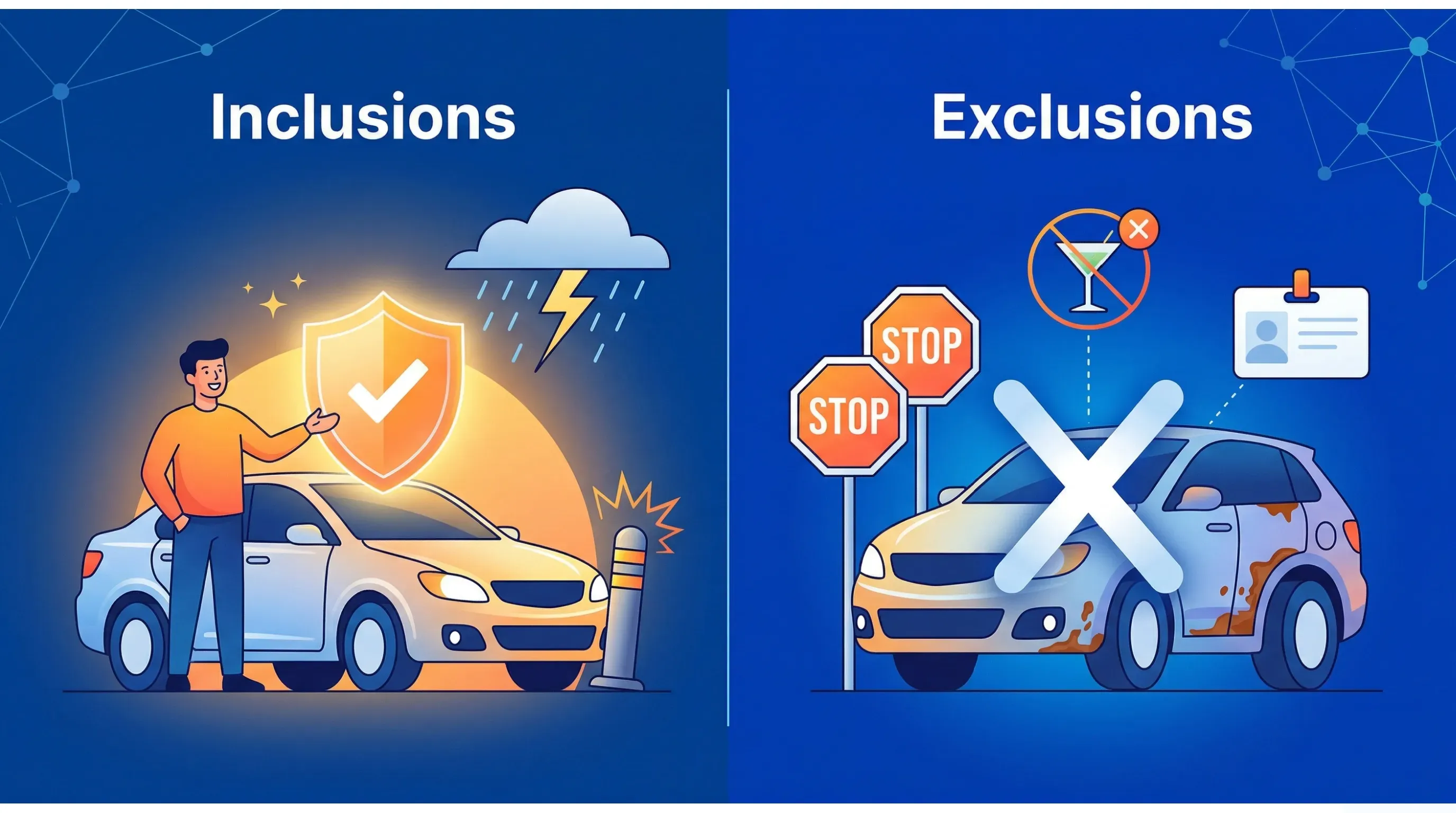
Contents

Key Inclusions in Motor Insurance
The popular inclusions in motor insurance are explained below.
1. Accidental Vehicle Damage
If your car is damaged in an accident, comprehensive insurance will cover the cost of repairs or replacement. No matter what the cause of the damage, the insurance will cover your needs, such as a collision with another vehicle or an object, or the car overturning.
2. Theft and Total Loss
If your car is stolen or so badly damaged that it cannot be repaired (a total loss), the insurance company will compensate you according to the Insured Declared Value (IDV).
3. Natural Calamities
Typically, comprehensive policies cover the following natural disasters and the resulting damage:
Floods
Cyclones
Earthquakes
Landslides
4. Man-Made Disasters
The coverage is also made available for the following damage-causing events:
Riots
Strikes
Vandalism
Fire or explosions
5. Third-Party Liability
This is compulsory and covers the following:
Accident/injury resulting in the death of a third party
Damage to a third party's property
6. Personal Accident Cover
Some insurance policies come with personal accidental cover for the owner-driver as a built-in feature or as an add-on, which offers a payout in the case of dismemberment or death.
7. Add-On Covers (Optional but Valuable)
There are certain add-ons that you can get to make your policy better such as:
Zero depreciation cover
Engine protection
Roadside assistance
Return to invoice
Consumables cover
These various add-ons can be chosen as per your requirements and they will provide you with considerably better benefits while claiming.
Critical Motor Insurance Exclusions You Must Review
Where inclusions outline the coverage, exclusions set the point of no return for your claim. Motor insurance exclusions should be reviewed before purchasing a policy
1. Driving Without a Valid License
To begin with, if the driver is not duly licensed at the time of the accident, the insurance company will not even consider the claim.
2. Driving Under the Influence
The liabilities arising from the use of a vehicle under the influence of alcohol or drugs are outside the coverage.
3. Wear and Tear
Components of a motor vehicle degrade over time, and insurance does not cover:
Part deterioration due to age
Decrease in value or performance
Failures due to mechanical issues
It is one of the major areas of confusion for the insured.
4. Mechanical or Electrical Failure
There is an exclusion of your claim for the cases of failures that are internal in nature to your vehicle (not from accidents) unless you have a add on cover to your motor insurance, like engine protection.
5. Driving Outside Geographical Limits
Use of a vehicle outside the policy's covered geographical boundaries (in most cases, India) will result in non-payment of your claim.
6. Commercial Use of Private Vehicle
Personal vehicle used for commercial purposes (such as ride-sharing without proper endorsement) is a scenario in which your claim may be declined.
7. Consequential Damages
If you cause damage to your vehicle through negligence after the first incident, you would be responsible for bearing the cost. For example:
Driving a flooded car and causing engine damage
8. War and Nuclear Risks
Damages resulting from war, invasion, or nuclear risks are the kinds of losses that do not find a place in the motor insurance policy coverage anywhere in the world.
9. Policy Lapse
If you fail to renew your policy on time and the incident happens during the lapse of your policy, you will be without cover.
10. Unauthorised Modifications
Making changes to your car without informing the insurer, like changing the engine or the frame, can result in denial of your claim.
Why Reviewing Exclusions is Crucial
Many policyholders perceive that "comprehensive" stands for "every single thing is covered". Such an interpretation is incorrect.
Getting to know the exclusions is advantageous for you to:
Don't get your claims rejected
Pick the most suitable add-ons
Operate your vehicle responsibly in accordance with the policy terms
Have the right information to make your financial decisions
For instance, if your house is in an area susceptible to floods, you may cost yourself a lot of money on repairs if you don't cover the engine. However, the engine protection package can save you from such costs if those types of losses are usually not included.
How to Choose the Right Motor Insurance Policy
When you study and compare insurance policies, don't only focus on the premium amount. Make sure you take into account the following points:
1. Coverage vs Cost
Sometimes a cheaper policy can be more limited, with many exclusions or fewer benefits. You should always check what you get for what you pay.
2. Add-On Flexibility
The best choice is insurers who will let you pick the add-ons that fit your driving habits.
3. Claim Settlement Ratio
Choose insurance companies with an excellent record of making swift, fair claim settlements.
4. Network Garages
Having a large network of garages ensures you can have your car repaired without paying in cash (cashless) and that it will be very convenient for you.
5. Customer Support
Good, prompt customer support can be really helpful, especially in emergencies.
Final Thoughts
Motor insurance really serves as a financial safety net, not just a regulatory requirement. Whereas inclusions highlight the benefits, exclusions reveal the limits of your insurance coverage.
Make sure you check both carefully before deciding to buy a policy. Do your research; make comparisons, and go for the right add-ons. A wise decision today can save you from sudden costly problems in the future.
Getting a firm handle on the exclusions and inclusions in motor insurance is a great way to safeguard your vehicle and be relaxed knowing that your peace of mind will be intact each time you take your car out.
Frequently Asked Questions on Motor Insurance Exclusions and Inclusions
FAQs

1. What are the most common exclusions in motor insurance?
Some typical motor insurance exclusions are wear and tear, breakdown due to mechanical or electrical failures, driving under the influence of intoxicants, driving without a licence, engaging in racing or other illegal activities, war and nuclear risks, and damages outside the geographical limits of the policy.
2. Will my insurance claim be rejected if I don't have a valid driving licence?
If you do not have a valid driving licence when the accident occurs, your claim is likely to be denied by the insurer. Besides, it is a criminal offence and you can be penalized following provisions of the Motor Vehicles Act.
3. Which parts or items are usually not covered under car insurance?
Generally, car insurance policies exclude supply and replacement of consumables such as tyres, tubes, engine oil, nuts and bolts, and lubricants. Coverage for such items is provided only if you purchase add-ons such as zero depreciation or consumables cover.
4. What happens if my motor insurance policy has expired and I meet with an accident?
If the policy has expired, then you don't have any coverage. Damages or losses during this time will be your responsibility and you will have to pay for the reparations yourself.
5. Can I use a private car insurance policy for commercial purposes?
Using a private car insurance policy while the vehicle is being used for business-related purposes is not allowed. The insurance company can reject your claims if they find out the vehicle is a commercial one and you do not have a commercial vehicle insurance policy.

Was this article helpful?

Recent
Articles
No Insurance, No Fuel: What the Supreme Court's Pilot Means
Nikhila PS Aug 6, 2026
Supreme Court Extends Third-Party Insurance for New Cars to Four Years
Nikhila PS Aug 6, 2026
Do ADAS Features Reduce Car Insurance Premiums in India?
Nikhila PS Jun 25, 2026
How Do BS6 Bikes Affect Bike Insurance Premiums and Coverage?
Nikhila PS Jun 25, 2026
Top 15 Car Companies in India in 2026
Nikhila PS Jun 25, 2026
All Articles


Want to post any comments?

ACKO Car insurance price starting at just ₹2,094*
Buy or Renew Insurance Online in 2 Minutes ⚡️
UID: 6274 | **T&Cs Apply

Getting a brand new car?
Save up to ₹40,000* on your insurance
UID: 6274 | **T&Cs Apply

Check prices


#36/5, Hustlehub One East, Somasandrapalya 27th Main Rd, Sector 2, HSR Layout, Bengaluru, Karnataka 560102