Home / Car Insurance / Articles / What is RPM in a Car and a Bike
What is RPM in a Car and a Bike
Nikhila PSSept 8, 2026
Share Post
RPM stands for revolutions per minute and indicates how many times your engine's crankshaft (the main spinning shaft inside the engine) turns in one minute. You read it on the tachometer, the dial on your dashboard, which shows how hard the engine is working at that moment. The basic function of this measure is to tell the working pace of the engine, which will be reflected in the speed, economy of fuel, and force of the vehicle.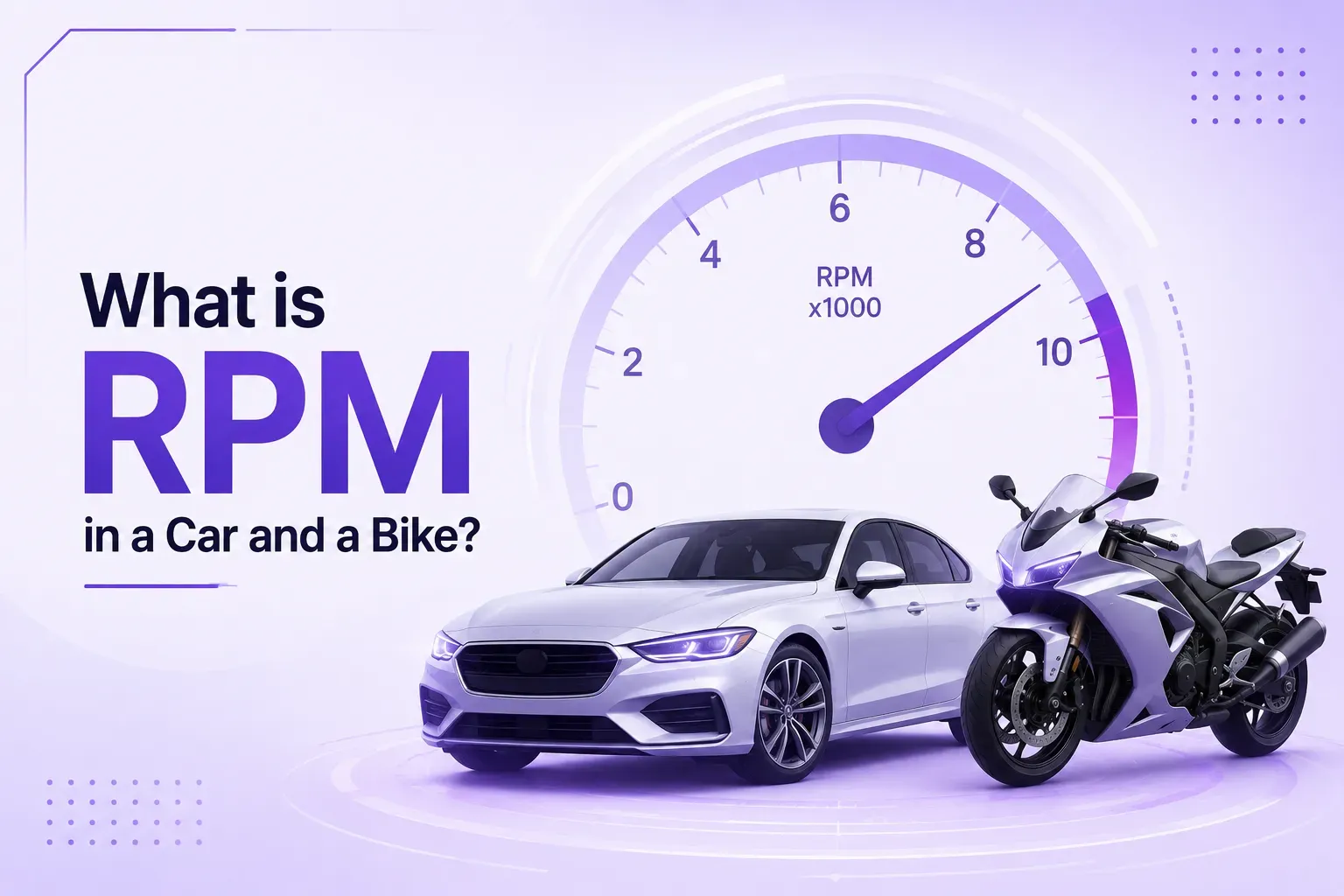
Contents

- What is the Full Form of RPM and What Does It Mean?
- How Does RPM Work in a Car and Bike Engine?
- How Do You Calculate RPM?
- What is the Ideal RPM Range for a Car and a Bike?
- How Does RPM Affect Fuel Efficiency and Engine Life?
- How Can You Keep Your Engine in the Right RPM Range?
- Key Takeaways
- Frequently Asked Questions
What is the Full Form of RPM and What Does It Mean?
RPM stands for revolutions per minute, also known as rotations per minute. This measurement gives the number of times that a crankshaft completes one full turn in 60 seconds. The measurement is displayed in thousands; therefore, "3" on the dial indicates 3,000 RPM.
A high value indicates that the engine is rotating rapidly and exerting itself. A low value indicates that it is turning slowly and is at ease. The value varies as soon as you press or release the accelerator.
The same thing is true for a car and a bike. The only difference is the range, since a small bike engine can spin much faster without risk compared to a large car engine.
How Does RPM Work in a Car and Bike Engine?
The RPM gauge measures engine speed, not the car's speed on the road. By pushing on the gas pedal, the engine receives increased fuel and air, the crankshaft rotates at a higher frequency, and so does the RPM. Releasing the pedal causes the RPM to decrease.
The tachometer receives this speed and displays it as a needle or a digital figure. When the engine is on at a standstill, the idle RPM will be indicated on the tachometer. For most cars, this is typically in the range of 700 to 1, 000, and for bikes, it is slightly higher.
There is a difference between road speed and RPM. When a car is in a low gear, the engine runs at a high speed even though the car moves slowly on the road. When it is in high gear, the engine runs at low speed even though the car moves quickly on the road. This is why driving at the same 40 km/h can result in two very different RPMs depending on the gear you are in.
How Do You Calculate RPM?
You do not have to calculate RPM manually, since the tachometer displays it instantly. Essentially, the concept is straightforward: RPM is merely the quantity of crankshaft rotations counted in a minute.
To calculate engine RPM from a given road speed, mechanics rely on this formula:
RPM = (Speed × Overall Gear Ratio × 336) ÷ Tyre Diameter in inches
The 336 is a constant used to convert speed and tyre size to engine revolutions.
The total gear ratio is the product of the gearbox ratio and the final drive ratio.
For example, a car moving at 70 mph in top gear with a 3.73 ratio and a tyre diameter of 31.6 inches will have an engine speed of around 2, 100 revolutions per minute.
The main reason to learn the formula is when you want to tune or change tyres. When you drive, the dial usually provides all the information you need.
What is the Ideal RPM Range for a Car and a Bike?
The best engine rpm to run your car or bike in regular driving is around 1, 500-3000 for cars whereas 2, 000-3, 000 for most bikes when cruising. Besides providing smooth engine operation, this also helps in saving fuel. In general, petrol cars have a somewhat higher range, about 2, 000 3, 000. In contrast, diesel cars lower their range likely around 1, 500 2, 500.
Above the dial, a red line marks the danger zone, indicating the maximum revolutions per minute (RPM) the engine can sustain without damage. Regular operation of a car is usually redlined between 6, 000 and 7, 000 RPM, while motorcycles are capable of revving up to 10, 000 RPM or even higher.
Holding the engine at redline for extended periods causes heavy wear and can damage it. Anyone who handles car insurance renewal and servicing on time will tell you a well-maintained engine lasts longer. Touching the redline once will not harm the engine, but living there will.
How Does RPM Affect Fuel Efficiency and Engine Life?
Higher RPM provides more power but consumes more fuel, whereas lower constant RPM results in better mileage. When the engine spins faster, it is drawing in more fuel per minute. Thus, by short-shifting into a higher gear earlier, you keep the RPM low and make your fuel last longer.
Constant high RPM also wears the engine faster. More turns per minute means more heat, more friction, and more strain on moving parts over time. That same wear is one reason a comprehensive car insurance policy is paired with regular servicing, so small problems are caught before they grow.
The same logic holds for a two-wheeler. Riders who buy bike insurance online and ride within the smooth RPM band tend to see steadier mileage and fewer engine complaints. Smooth driving is cheaper driving.
How Can You Keep Your Engine in the Right RPM Range?
Depending on the situation, you can keep the car's RPM in the desired range by shifting gears at the right time and gently releasing the accelerator. Usually, the needle on the dial should not go beyond 2,500 to 3,000 under normal traffic conditions; that is the rule of thumb for shifting up. This rule achieves an engine that is relaxed and quiet.
Some of the habits that can help include:
When the engine is getting loud or feeling like it is being pushed, tip it to an early shift up
To prevent the car or bike from jolting when the RPM falls too low, one should shift down in good time
Do not make full-throttle starts at hard conditions without any compelling reasons
A tachometer should be used for reference, along with the sound of an engine
It is always a good idea to check the idle RPM if it is constantly fluctuating or stays too high, as it might indicate a sensor or air intake problem. Staying within the engine's calm band will not only keep fuel costs low but also support the vehicle's longevity.
Key Takeaways
RPM stands for revolutions per minute, basically the number of times the crankshaft rotates in a minute. It is a measure of the engine's workload rather than the vehicle's speed.
The tachometer is the instrument that shows the current RPM, and the redline indicates the maximum safe RPM. Staying constantly in the redline zone overheats and excessively wears out the engine, which may cause damage.
Normally, the best cruising RPM is between 1,500 and 3,000 for cars and between 2,000 and 3,000 for motorcycles. Diesel engines usually have a lower RPM range, while petrol engines have a bit higher range.
An increase in RPM results in higher fuel consumption and accelerated engine wear, whereas maintaining smooth low RPM conserves both. Performing an early gear shift and reducing the throttle can keep the engine quiet.
Frequently Asked Questions
Mostly Asked Questions on What is RPM in a Car and a Bike

What is a normal RPM for a car at idle?
Generally, a car idles between 700 and 1, 000 RPM when the engine is running but the car is stationary. Motorcycles, however, tend to idle slightly higher, usually in the range of 1,000 to 1,500 RPM. An engine that idles smoothly is typically healthy.
Does higher RPM always mean higher speed?
No. The RPM indicates how fast the engine is running, not how fast the car is going. When the vehicle is in a low gear, the engine can turn very fast even though the vehicle is moving slowly.
Is driving at high RPM bad for the engine?
Occasionally, accelerating to very high RPM is okay, but deliberately keeping the engine at very high RPM for extended periods will generate significant heat and cause wear. For everyday driving, it is best to stay in the 1,500-3,000 range.
Why is the ideal RPM different for petrol and diesel cars?
Diesel engines develop most of their power at low RPMs; hence, they operate quite comfortably at around 1,500 to 2,500 RPM for cruising. Petrol engines on the other hand, require a higher number of revolutions, so their normal driving speeds will correspond to the RPMs of 2,000 to 3,000.
At what RPM should I shift gears?
In relaxed everyday driving, change to higher gear before the needle passes roughly 2, 500 to 3, 000 RPM. Move down a gear when the RPM is about to drop to a very low level that causes the vehicle to judder.

Was this article helpful?

Recent
Articles
No Insurance, No Fuel: What the Supreme Court's Pilot Means
Nikhila PS Aug 6, 2026
Supreme Court Extends Third-Party Insurance for New Cars to Four Years
Nikhila PS Aug 6, 2026
Do ADAS Features Reduce Car Insurance Premiums in India?
Nikhila PS Jun 25, 2026
How Do BS6 Bikes Affect Bike Insurance Premiums and Coverage?
Nikhila PS Jun 25, 2026
Top 15 Car Companies in India in 2026
Nikhila PS Jun 25, 2026
All Articles


Want to post any comments?

ACKO Car insurance price starting at just ₹2,094*
Buy or Renew Insurance Online in 2 Minutes ⚡️
UID: 6274 | **T&Cs Apply

Getting a brand new car?
Save up to ₹40,000* on your insurance
UID: 6274 | **T&Cs Apply

Check prices


#36/5, Hustlehub One East, Somasandrapalya 27th Main Rd, Sector 2, HSR Layout, Bengaluru, Karnataka 560102