Company logo
Products
Enterprise
Why ACKO?
Support
Renewals
New to ACKO?
Renew health insurance
Renew car insurance
Renew bike insurance
Renew life insurance
Existing ACKO Customer
Login and renew policy
Claims
File a claim
Track a claim
Login
Car insurance
Bike insurance
Health insurance
Life insurance
Travel insurance
The only pass that pays you back for flight troubles
Know more

airpass
Stories that
speak for ACKO
Know more
About Us
Careers
Customer stories
Stories that
speak for ACKO
Know more
Stories that
speak for ACKO
Know more
Term Life Insurance that Welcomes Change

1 Crore Term Insurance Starting @ ₹18/day*

key-features-0

18% Cheaper Now - Zero GST

Get instant savings with zero extra charges.

key-features-1

99.29% Claim settlement ratio*

Proven reliability your family can count on.

key-features-2

Save up to ₹54,600* on your taxes

Earn smart tax benefits while you protect.

ARN: L0130 | *T&C Apply
background-image-desktop-widget

Term insurance

Term insurance is the purest form of life insurance, meant only for protection. A term insurance plan offers financial protection for a fixed period in return for a regular premium. The money your nominee receives as a payout (called the death benefit) can help cover important costs such as your children’s education, healthcare expenses, and daily needs like food and clothing.

What is Term Insurance?

Term insurance is the most affordable type of life insurance. A term insurance plan works on a simple principle: you pay a fixed premium for a chosen period (called the policy term), and if you pass away during that time, your family receives the sum assured (death benefit). It focuses only on protecting the financial needs of your dependents in your absence. Since it does not include any savings or investment component, the entire premium goes towards life cover, which is why term insurance premiums are cheaper.

Term insurance is not a savings or investment plan. It does not offer maturity benefits or returns. Its only purpose is to provide financial protection to your family if you are no longer around to support them.

Key Characteristics of Term Life Insurance

  • Pure protection: No cash value or maturity benefits
  • High coverage at lower cost: Designed to provide large life cover at affordable premiums
  • Fixed premiums: Premium amount remains the same throughout the policy term
  • Flexible policy terms: Choose coverage for 10 to 40 years
  • Tax benefits: Premiums may qualify for tax deductions under Section 80C, and death benefits are tax-free under Section 10(10D), as per applicable laws
  • GST Benefit: Term insurance premiums are currently exempt from GST.

ACKO Life’s Philosophy: Pure Protection, Unmixed

At ACKO Life Insurance, we believe life insurance should do one thing well: protect your family financially in case you are not around. It stands between uncertainty and your family’s financial security. That’s why ACKO Life’s sole focus is on providing straightforward life protection, without any hidden agendas. We offer only term life insurance, built purely to do what life insurance is meant to do: protect.

While many life insurance products combine protection with savings or investments, we keep term insurance clear and purpose-driven, so its role is never diluted. By separating life insurance from complicated investments, we deliver transparent and genuine value. This protection is easy to understand, affordable to maintain, and dependable when families need it most.

What Pure Protection in Term Insurance Means for You

Pure protection isn’t just a concept. Here’s how it shows up in practical ways for you and your family.

  • Singular Purpose: Life Protection 
    Term insurance is designed with one clear goal: to protect your family financially in case you are not around. It stands between uncertainty and your family’s financial security.
    That’s why ACKO Life's sole focus is to provide straightforward life protection, without any hidden agendas. We offer only term life insurance, built purely to do what life insurance is meant to do: protect.
  • Clarity for Loved Ones
    A simple and transparent policy structure makes it easier for families to understand the cover. During difficult times, this clarity helps them claim the benefit without added confusion or stress.
  • Purity is Care
    By removing unnecessary features, it stays simple, affordable, and easy to manage over the long term.
  • The Good in Unmixing
    When life insurance is kept separate from investments, expectations are clear from the start. This creates transparency and builds trust in how the policy works.
     

Key Features of ACKO Life Flexi Term Plan

The ACKO Life Flexi Term Insurance Plan is built around the core purpose of term insurance, protecting your family financially. It focuses only on life cover, without combining protection with savings or investment components. At the same time, it offers flexibility in coverage options, allowing you to choose a plan that fits your life stage and responsibilities.

Below are the key features of the ACKO Life Flexi Term Insurance Plan.

CategoryDetails
  
Sum Assured₹10 lakh up to ₹90 crore
Entry Age18 to 65 years
Policy TermFlexible policy term options available
PremiumsDesigned to be affordable for long-term life cover
Tax BenefitsAvailable as per applicable tax laws
Claim Settlement Ratio99.29%
Claim ProcessFully digital process with document upload.
Death BenefitAvailable
Critical Illness CoverAvailable
Accidental Death BenefitAvailable
Accidental Total Permanent Disability CoverAvailable
Claim AssistanceDedicated support for claims
Customisable CoverageAvailable

How Much Does Term Insurance Cost?

The cost of term insurance depends on a few basic factors, such as your age, the amount of life cover you choose, the policy term, and your health and lifestyle. Since term insurance focuses only on life protection, it is generally more affordable than other types of life insurance.
The easiest way to know how much your term insurance will cost is to calculate it based on your age, income, and coverage needs.

You can get ₹1 crore term insurance coverage starting at just ₹18/day*

When Should I Buy a Term Insurance Plan?

The right time to buy a term insurance plan is as early as possible, because the earlier you buy, the cheaper it is and the longer your family stays protected. When you wait even 5-10 years to buy term insurance, your premium can increase by thousands, and you will have a shorter number of years of protection.
The image below explains how buying term insurance early can help reduce premiums.

₹1 Crore term insurance: premiums rise with age, ₹7,461 at 25, ₹8,550 at 30, ₹11,376 at 35—buy early to save

₹1 Crore term insurance: premiums rise with age, ₹7,461 at 25, ₹8,550 at 30, ₹11,376 at 35—buy early to save

Why Term Insurance is Important for Your Family

Life often comes with long-term responsibilities. These can include repaying loans, supporting your children’s education, managing everyday household expenses, and taking care of ageing parents.

Without adequate life insurance, families may have to:

  • Rely on savings
  • Sell assets
  • Depend on others for financial support

Term insurance helps provide financial stability during such times by ensuring your family has a dedicated life cover. It is designed to replace lost income and support your loved ones in maintaining their standard of living, even in your absence.

Types of Term Insurance Plans in India

There are different types of term insurance plans available in India. While the core purpose remains life protection, these plans vary in structure and features.

Plan TypeMaturity BenefitCoverage Pattern
   
Pure Term (Level)NoneFixed throughout
Term with Return of PremiumPremiums returnedFixed throughout
Increasing CoverNoneIncreases periodically
Decreasing CoverNoneDecreases over time
Convertible TermNoneFixed, can convert later
Group Term Life InsuranceNoneEmployer-linked

1. Pure Term Insurance Plan (Level Term Insurance)

This is the most basic and popular type of term plan where the sum assured remains fixed throughout the policy term.


Features:

  • Fixed death benefit for the entire policy term
  • Lowest premium among all types
  • Simple and understandable

Best for: Anyone looking for inexpensive life coverage without additional features.


2. Term Insurance with Return of Premium (TROP)

TROP provides life cover and also returns all your premiums if you survive the policy term.


Features:

  • Get back 100% of premiums if you outlive the term
  • The premiums are higher, about 1.5 to 3 times more expensive than pure term plans.

Best for: People who want life protection along with the assurance of getting their money back at the end of the term.


3. Increasing Cover Term Plan

With an increasing term insurance plan, your coverage automatically increases every year to keep pace with inflation or growing responsibilities.


Features:

  • The coverage increases by a fixed percentage, usually between 5% and 10% annually.
  • Helps cover future needs as your income and expenses grow
  • Premium usually remains the same or increases slightly.

Best for: Young professionals who expect their income, lifestyle, and financial needs to increase over time.


4. Decreasing Cover Term Plan

With a decreasing term insurance plan, your coverage amount decreases gradually during the policy term, matching your loan balance.


Features:

  • Good option to cover liabilities like home or business loans
  • Lower premiums as compared to regular term plans
  • The coverage decreases as your outstanding debt goes down.

Best for: Borrowers who want protection for large loans that reduce over time.


5. Convertible Term Plan

It allows you to convert your term plan into a whole life or endowment policy later, without the requirement of any medical tests.


Features:

  • Easily convert to a permanent life insurance plan
  • No fresh medical check-up needed
  • Useful if your long-term financial goals change

Best for: Individuals who are unsure of their needs in the future and would like flexibility to switch plans later.


6. Group Term Life Insurance

It is a term life insurance policy provided by the employer to employees as an additional benefit.


Features:

  • Employer pays the premium
  • Coverage is usually 3-5 times your annual salary
  • No medical test needed for basic cover
  • Coverage ends when you leave the company

Best for:  Employees desiring basic life insurance through their workplace.

Term Insurance vs Other Life Insurance Plans

Life insurance plans are designed for different needs. Understanding how term insurance compares with other life insurance options can help you choose a plan that matches your priorities and financial responsibilities.

At ACKO Life Insurance, the approach to life insurance is centred on clarity and a singular purpose: providing 100% pure protection without any added complexities. With that perspective, here’s how term insurance compares with other types of life insurance plans.

AspectTerm InsuranceInvestment-Linked Life Insurance Plans 
   
Primary purposeLife protectionProtection combined with savings or investments
Premium costLowerHigher
ReturnsNo returnsMay offer returns based on market or policy performance
Life coverHigher cover for the same premiumLower cover for the same premium
ComplexitySimple and easy to understandMore complex structures
FocusFinancial security for the familyLong-term savings along with insurance
Example1 crore term insurance2 crore term insurance50 lakhs term insuranceULIPs, endowment plans, and savings-linked life insurance

Note: Investment-linked plans combine insurance with savings or investments, while term insurance keeps the focus only on providing life cover.

Term Insurance vs Return of Premium (TROP)

Return of Premium plans are often compared closely with term insurance because both provide life cover.

AspectTerm InsuranceReturn of Premium (TROP)
   
Life coverYesYes
Maturity benefitNoPremiums paid are returned at the end of the policy term
Premium amountLower1.5 to 3 times more expensive
Cost structureFocused only on protectionIncludes a refund element
Overall focusPure life protectionProtection with a refund feature

Why ACKO Life Does Not Offer Term Insurance with Return of Premium (TROP)

ACKO Life Insurance does not offer plans with a return or savings element, as such features add cost and complexity. The focus remains only on pure life protection.

With Return of Premium plans, there are a few things to keep in mind.

  • Higher premiums: You pay about 1.5 to 3 times more compared to pure term insurance. 
  • Lower life cover for the same cost: Higher premiums may reduce the amount of protection your family receives.
  • No growth on the refunded amount: The premiums paid remain locked in and do not grow over time. With lower premiums under pure term insurance, you can save money to invest separately and earn returns over time.
  • Added complexity: The refund element makes it harder to clearly understand what you are paying for protection.

How Term Insurance Works?

Let’s understand how term insurance works in the simplest way possible. All you need to do is follow these simple steps to see how a term plan protects your family:

1. Find out the Right Coverage Amount

The first step is to figure out how much term insurance coverage you actually need. The coverage amount is also known as the sum assured (the money your family would receive if you pass away). So, it’s one of the most important decisions because it directly affects your family’s financial security and also your policy premium.

2. Choosing the Right Policy Term

The next thing you’ll want to do is choose how long you want your term insurance coverage to last. The policy term means how many years your plan will provide protection, and there are some simple ways to decide this:

  • Until retirement: This is the most common choice (e.g., 30-year term for a 30-year-old)
  • Until a major financial goal has been reached, such as children's education or home loan repayment.   
  • Until dependents become financially independent: 20-25 years.

3. Selecting Premium Payment Option

Now that you have determined your term insurance coverage and policy term, your next step is to choose your premium payment option. The premium payment option can impact your budget, payment convenience, and long-term financial planning; thus, it is best to choose a premium payment option that you are comfortable with. You can choose either:

1. Regular Pay:

  • Pay monthly, quarterly, or yearly throughout the policy term. 
  • Many people prefer the annual payment option because it offers convenience and may come with small savings.
  • It is suitable if you have a steady, ongoing income.

2. Limited Pay (10-15 years):

  • Pay for a shorter duration and get life coverage for the entire policy term.
  • Higher annual premium but lower total outgo
  • Suitable for high-income earners

4. Medical Underwriting

When you buy a term insurance plan, you’ll need to go through a quick medical check-up. This step is called medical underwriting. This is an important step of the process because it ensures your premiums are based on your actual health conditions.

  • Health details help determine premiums
  • Medical tests may be required for higher cover
  • Honest disclosure is important

5. Policy Issuance

Once your application and medical underwriting are done, your term insurance policy is issued. This is when your coverage officially starts, and you will receive your policy document (digitally or physically) with all the details about your plan.

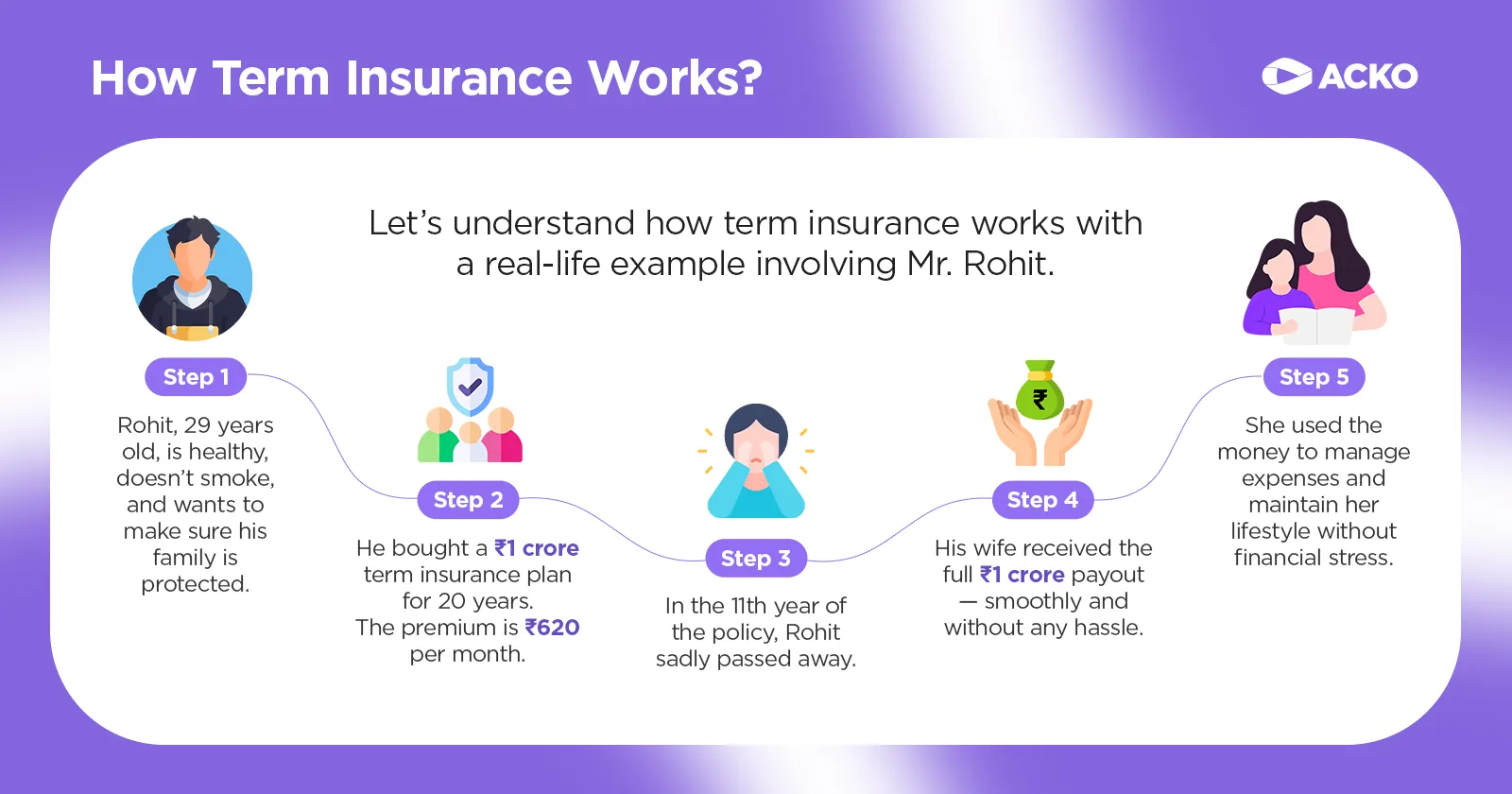
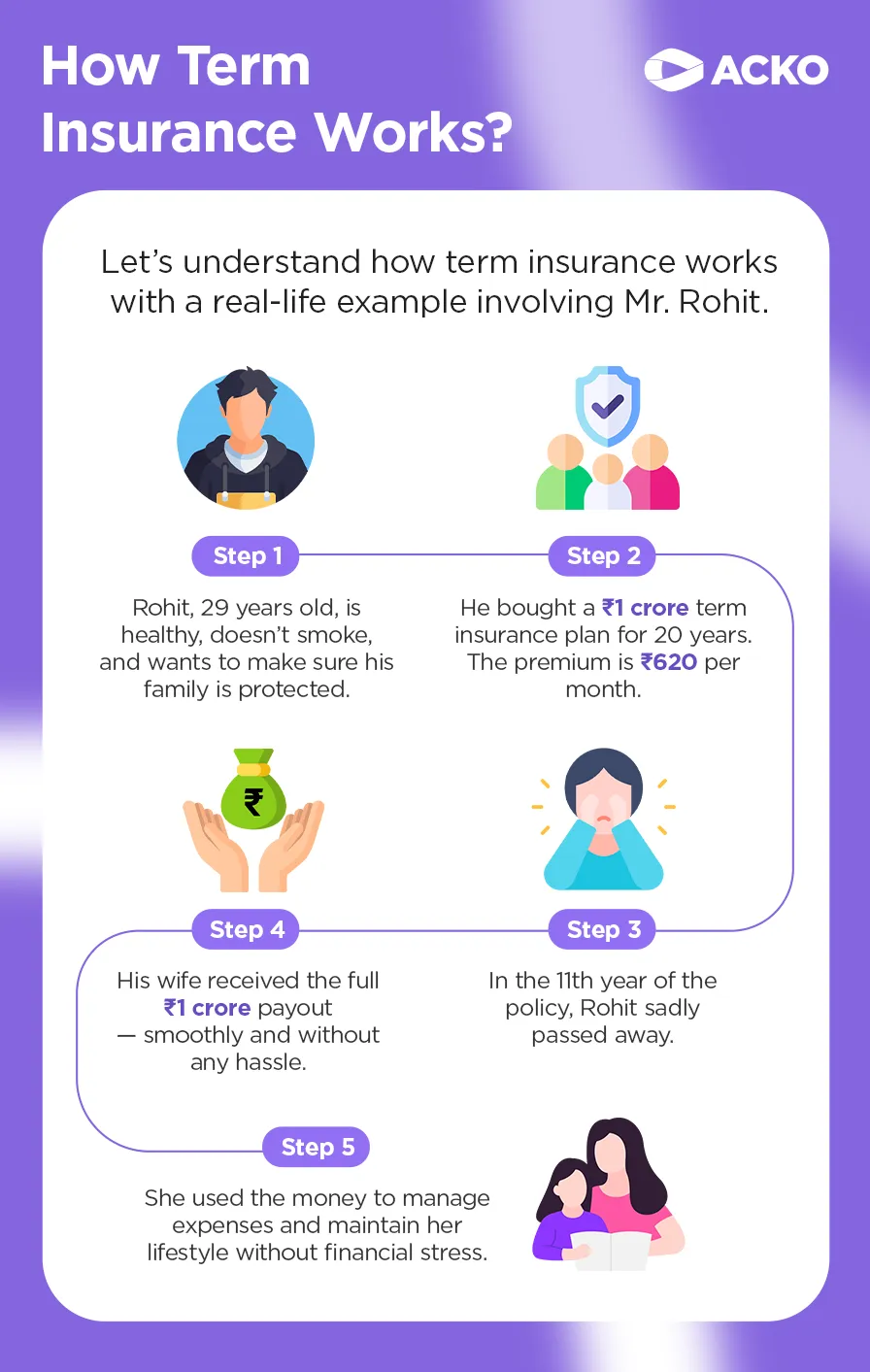
Step-by-step explanation of how term insurance works with example of Mr. Rohit — buying a ₹1 crore policy, paying ₹620 monthly premium, and family receiving payout after his death

how-term-insurance-works-example-rohit-acko.webp.mweb

Key Benefits of Term Insurance

1. Huge Coverage at Low Cost

Among all life insurance products available, term insurance provides the highest coverage at the lowest premium.

Comparative costs (aged 30 male, ₹1 crore term insurance  cover):

  • Term insurance: ₹8,000-10,000/year
  • Traditional endowment plan: ₹3-6 lakh per year (estimated range for ₹1 crore cover; varies by insurer and policy term)

2. Financial Security for Dependents

Term insurance focuses only on protection, which allows higher coverage at lower premiums compared to other life insurance plans. Here’s how term insurance helps your loved ones in real life:

  • Gives immediate money to manage funeral or emergency expenses
  • Helps your family repay loans like home or personal loans
  • Acts as an income replacement
  • Keeps your children’s education plans secure
  • Ensures your spouse’s retirement plans remain safe and steady

3. Tax Benefits: Dual Advantage

  • Section 80C Benefits: Premiums paid are deductible up to ₹1.5 lakhs annually.
  • Section 10(10D) Benefits: Tax-free death benefit to nominees.

4. Debt Protection

Household debt refers to the total amount of money families owe to banks or financial institutions, which includes home loans, car loans, education loans, personal loans, and credit card loans. How term insurance helps:

  • Prevents a forced sale of property
  • Protects co-borrowers from the burden
  • Maintains the credit score of the surviving family members

5. Peace of Mind

Term insurance removes that persistent thought in the back of one's mind: "What would happen to my family were I not around?" Here's how such peace of mind helps in daily life:

  • If you're less stressed about the future, you can then focus more on your career and goals.
  • When you feel secure, it leads to stronger and happier family relationships.
  • You can plan long-term without fear of leaving unfinished responsibilities.

6. Flexible Payout Options (Death Benefit)

Choose how your family receives money:

  • Lump Sum: The whole amount in one payment. It is suitable for immediate debt clearance. 
  • Income Benefit (Instalments): Monthly/annual payouts for a specified period. It ensures a steady income flow and prevents the misuse of a large amount.
  • Combination: 50% in lump sum + 50% in instalments. 

Which Factors Affect Term Insurance Premiums?

Several key factors affect premiums for term insurance plans. Some of them include your age, health, lifestyle habits, coverage amount, and policy duration.

FactorHow does it affect the premium
AgeYour age plays a big role. The younger you are when you buy a term insurance policy, the lower your premium will be. 
Sum assuredHigher coverage amounts generally lead to higher premiums because the life cover amount is greater.
Policy termThe length of your insurance policy will also affect the premium. A longer policy term will attract higher premiums than a shorter policy term.
Health historyYour current health and your medical history have a big impact on your premiums.
Lifestyle habitsSmoking or alcohol use can lead to higher premiums because of increased mortality risk.
OccupationYour profession and lifestyle activities affect your risk profile and premium rates.
GenderStudies indicate that women, on average, live longer than men. Thus, women typically pay lower premiums due to higher life expectancy.

What is the definition of a smoker by insurers?

To insurers, “smoker” means not just someone who smokes cigarettes. It includes someone who consumes any form of nicotine.

This includes:

  • Cigarettes, cigars, pipes
  • Chewing tobacco, gutka, paan masala
  • Electronic cigarettes
  • Any other form of consumption of nicotine

How to Buy Term Insurance Online?

The process to buy a term plan is simple and straightforward. Follow the steps below:

  1. Step 1.svg

    Enter basic details online

    Add details like your age, income, and lifestyle information to get an estimate.

  2. Step 2.svg

    Choose your coverage and policy term

    Select the life cover amount and policy duration based on your needs. Use online premium calculators to get an estimate of the right coverage amount and premiums. 

  3. Step 3.svg

    Medical Tests (if required)

    Answer health-related questions honestly. The medical tests required depend on your age and the coverage amount you're applying for. Some of the common term insurance medical tests include basic physical examination(height, weight, blood pressure), Blood tests, etc. 

  4. Step 4.svg

    Make the payment

    Once approved, complete the payment to activate your policy. Some of the common payment modes include Net banking, Debit/Credit card, UPI, and Digital wallets.

Tip: Pay annually to save compared to monthly payments

How to Choose the Right Term Insurance Plan

Choosing a term insurance plan is about understanding what your family may need. Instead of looking for the “best” plan, it helps to focus on a few key factors that determine whether a plan is right for you.

  1. 1. Decide how much life cover you need

    Start by estimating how much financial support your family would need if you are no longer around. This usually depends on your income, existing loans, everyday expenses, and future responsibilities such as children’s education or family care.
    A sufficient life cover ensures your family can manage their lifestyle and obligations without financial strain. When calculating the right coverage amount, there are two simple ways to estimate your needs:


    A. Human Life Value Method: 

    Annual Income × Number of working years remaining

    Let’s say you’re 35 years old and earn ₹12 lakh per year. You plan to retire at 60, which means you have 25 working years left.

    According to the Human Life Value (HLV) method, your ideal life insurance cover would be: ₹12 lakh × 25 years = ₹3 crore


    B. Needs-Based Calculation: 

    Coverage needed = Total Financial Obligations + Emergency Fund + Future Goals. 

    It is calculated based on your family’s financial needs and goals. Let’s say, you have a home loan of ₹60 lakhs, Education fund for 2 children: ₹50 lakhs, Parents' healthcare reserve: ₹20 lakhs, Family's 10-year expenses (₹6 lakhs annually): ₹60 lakhs and Emergency fund: ₹10 lakhs. 

    Then, the total coverage needed is ₹2 crore.

  2. 2. Choose an appropriate policy term

    The policy term is how long your life cover remains active. Many people choose coverage until retirement or until their dependents are financially independent. Selecting the right policy term helps ensure protection during the years it is needed most.

  3. 3. Understand the claim settlement approach

    A term insurance plan is meant to support your family at a difficult time. It is important to understand how the claim process works and whether it is clear, transparent, and easy for your loved ones to follow.

  4. 4. Look for simplicity in policy terms

    Simple policy terms make it easier for families to understand what is covered and how claims work. Avoid plans that mix protection with multiple features that may add complexity or confusion later.

  5. 5. Consider premium affordability

    Choose a premium amount that fits comfortably within your long-term budget. Since term insurance is a long-term commitment, affordability plays a key role in keeping the policy active without stress. 

  6. 6. Focus on pure life protection

    At its core, term insurance is meant to provide life protection. Plans that focus only on this purpose keep the intent clear, costs lower, and coverage straightforward for families.

  7. Read more about other term insurance options based on your life stages and financial goals.

    Term Insurance for NRI

    Term Insurance for Senior Citizens

    Term Insurance for Housewife

How Much Term Insurance Cover Do I Need?

Your term insurance needs evolve as your responsibilities grow. Here is an illustrative guide to help you understand how coverage may change at different life stages.

Life StageAge RangeTypical Financial ObligationsSuggested Coverage RangeIllustrative Annual Premium Range*
     
Young Professional (Single)22–28Student loans, parents’ support₹50L – ₹1 Cr₹3,000 – ₹6,000
Newly Married28–32Home loan planning, spouse protection₹1 – ₹1.5 Cr₹8,000 – ₹12,000
New Parent30–35Home loan, child education₹1.5 – ₹2 Cr₹12,000 – ₹18,000
Growing Family35–40Loans + education for two children₹2 – ₹3 Cr₹18,000 – ₹30,000
Mid-Career40–45Remaining loans + college costs₹2 – ₹2.5 Cr₹25,000 – ₹40,000
Pre-Retirement45–55Final obligations + spouse security₹1 – ₹2 Cr₹40,000 – ₹80,000

Disclaimer: These are illustrative examples and not actual premium quotes. Premiums vary significantly based on your age, health, lifestyle, underwriting assessment, and insurer. Please use the term insurance calculator to get accurate, personalised estimates.

Term Insurance Calculator

You want to ensure your family's financial security in the event of your passing. However, you need to determine how much coverage you require or what the cost will be. That's where a Term Insurance Calculator comes in. In simple terms, a Term Insurance Calculator helps you determine how much insurance you need and how much it will cost. It's like a virtual assistant that takes the guesswork out of protecting your loved ones financially.

  • Provide basic information about yourself, such as your age and genderand how much money you want your family to receive if you pass away.
  • Answer a few simple questions about your habits and health conditions.
  • Then, the calculator performs some quick calculations and provides an estimate of how much you'll pay for the insurance each month or year. It also indicates how long the coverage will last (typically a specific number of years).

Here are some of the most common coverage options to explore: 

1 Crore Term Plan1.5 Crore Term Plan2 Crore Term Plan
3 Crore Term Plan5 Crore Term Plan7 Crore Term Plan
10 Crore Term Plan12 Crore Term Plan15 Crore Term Plan

Who Should Buy Term Insurance in 2026?

Buying a term insurance plan is a practical option for everyone, especially those who are financially dependent, to secure their family’s finances in case something unfortunate happens. Here’s a list.

  • Young and Healthy People: Buying term life insurance when you're young and healthy can be cheaper. It's like locking in a good deal for the future.
  • Earning Members: If you're the one who earns for your family, term life insurance is essential. It ensures your family won't face financial difficulties if you're no longer there to support them.
  • People with loans or EMIs: If you have loans or debts, like a home/personal/car loan, term life insurance can cover those debts so your family doesn't get burdened.
  • Taxpayers: If you're looking to save on income tax while securing your family's future, term life insurance is a smart choice. Premiums paid are eligible for tax deductions under Section 80C, and the payout to your family is tax-free under Section 10(10D).
  • Homemakers / Non-Working Spouses: Homemakers play an important role in running the household and supporting the family. Term insurance for non-working spouses helps ensure that daily needs like childcare, groceries, and household support are taken care of, in case of an unforeseen event.
  • Working Women: In today’s workforce, women stand shoulder-to-shoulder with men. Term insurance for working women offers tax savings and helps secure a family's financial future. Additionally, many plans include riders, such as critical illness coverage, for life-threatening illnesses commonly affecting women.
  • Newly Married Couples: When you're beginning your married life, term insurance provides financial protection for your spouse in case something happens to you. Buying early also means lower premiums.
  • Single Parents: If you're a single parent, your children depend on you entirely. Term life insurance can give you peace of mind, knowing that your kids will have financial support if something happens to you.
  • Estate Planners: If you want to leave your heirs and inheritance or financial legacy, term life insurance can help ensure they receive it.
  • Business Owners: If you own a business, term life insurance can be crucial to ensure the smooth transition of your business or to cover business debts in case something happens to you.
  • People with Ageing Parents or Dependents: Many Indians support their parents or siblings financially. A term plan ensures that your dependents won’t be left helpless in your absence. 

Eligibility Criteria To Buy a Term Insurance

To take a term insurance policy, you must fulfil certain eligibility criteria defined by the insurer. Knowing these criteria helps you select the appropriate plan.

  • Age Limit: The majority of insurers provide term plans to people aged between 18 and 65 years.
  • Income Criteria: Your income determines the maximum coverage amount you can choose.
  • Medical Fitness: Certain policies could ask for a medical test to evaluate your well-being.
  • Nationality & Residency: Applicable for Indians and NRIs according to insurance company guidelines.
  • Occupation & Lifestyle: Hazardous occupations or lifestyles like smoking could impact premium charges.

Note: Satisfying these conditions gives you a seamless approval process and brings you closer to ensuring your dear ones' future.

 What is Covered and Not Covered in Term Insurance?

Term insurance gives financial help to your family. However, it’s important to know what it does and doesn’t cover. Always read the policy document to understand the full list.

What is Covered in Term Insurance:What is Not Covered in Term Insurance:
  
Death Due to Illness Death Due to Suicide in the First Year
Death Due to AccidentsDeath from Risky Activities 
Death Due to COVID-19 or Other Pandemic DiseasesDeath from Criminal Acts
Death Due to Natural CausesDeath  Due to pre-existing illnesses (undeclared) 

Documents Required to Buy Term Insurance

When you apply for a term insurance plan, the insurer will ask for a few basic documents to confirm who you are, understand your health and finances, and decide the right coverage for you. Below is a list of the key documents required:

Document TypeIs It Mandatory?Why It’s NeededWhen It’s Required
    
Age Proof YesTo verify your age and calculate the correct premiumFor all applications
Identity Proof YesFor KYC and identity verificationFor all applications
Address Proof YesFor address verification and communicationFor all applications
PAN CardYesFor tax compliance and income verificationUsually required for all policies
Income Proof YesTo confirm financial eligibility for higher coverageWhen coverage exceeds ₹50 lakhs
Passport-size PhotographYesFor policy records and identity confirmationFor all applications
Medical ReportsConditionalTo assess health risks during underwritingWhen coverage exceeds ₹50 lakhs or the age is above 40
Bank Account Details YesFor premium payments, refunds, and claim payoutsFor all applications
3 Years ITRConditionalFor financial underwritingWhen coverage exceeds ₹1 crore
Net Worth StatementConditionalTo justify very high coverage amountsWhen coverage exceeds ₹5 crore

Documents Required for Life Insurance Death Claim

Before you file a term insurance claim, you need to have a few important documents ready. Here is a list of documents required for a life insurance claim as per IRDAI.

  • Death Certificate:  This is the most important requirement. This document verifies that the life insured has passed away as documented by the local municipal authority or hospital where the death occurred.
 
  • Policy Document: You'll also need a copy of the term life insurance policy, which will provide documentation for the coverage amount as well as the name of the beneficiary.
 
  • Medical Records: If the cause of death was medical, the insurance company may ask for the medical documents or reports related to the illness or cause.
 
  • Nominee/Beneficiary ID: The nominee or beneficiary who will receive the insurance payout will also need to provide proof of their identity.
 
  • Bank Details: You will also be required to submit the bank account information for the insurance money to be deposited. This is usually done through a cancelled cheque or a bank statement.
 

Additional documents (based on death circumstances):


For natural death:

  • Hospital records and medical reports
  • Attending physician's certificate
  • Medical history
 

For accidental death:

  • FIR copy
  • Postmortem report
  • Police investigation report
 

For death abroad:

  • Death certificate from that country (translated and attested)
  • Proof of travel
  • Embassy/Consulate certificate

How the Term Life Insurance Claim Settlement Process Works

This is how a claim settlement process for term life insurance works:

Step 1.svg

Notify the insurer

  • Call customer care
  • Email to the claims department
  • Visit the nearest branch
  • Get the claim number
 

Step 2.svg

Submission of the claim form

  • Download or obtain the claim form
  • Fill out the claim form and include the nominee’s information
  • Include all required documents
  • Physically submit or complete the submission online if available
 

Step 3.svg

A verification process

  • Verify documentation
  • Investigate if necessary (for claims made during the first three years of the policy, or circumstances appear questionable)
  • Verify medical records
  • Review the police report if the death was accidental
 

Step 4.svg

Claim Assessment

  • Review against policy terms
  • Check exclusions
  • Verify premium payment status
  • Calculate the payable amount
 

Step 5.svg

Claim Settlement

  • Approval notification
  • Payment processed (7-15 days after approval)
  • Amount credited to the nominee's account
  • Settlement letter issued

Note: Always keep copies of all submitted documents and maintain regular follow-up with the insurer’s claims team for updates.

Common Reasons for Term Insurance Claim Rejection and How to Prevent Them

Understanding why claims get rejected helps you avoid these pitfalls:

Rejection ReasonPrevention StrategyRemedy if Rejected
   
Non-disclosure of medical historyDisclose all health conditions honestlyUsually none (claim denied)
Material misrepresentationProvide accurate information in proposalVery difficult to overturn
Policy lapsed (non-payment)Set up auto-pay, pay within grace periodRevive policy within 2-5 years
Death during waiting period (suicide)Only first 12 months exclusionNone - premiums returned
Death due to excluded causesRead policy exclusions carefullyDepends on specific exclusion
Documentation incomplete/incorrectSubmit all original documents promptlyResubmit with correct documents
Suspicious circumstancesMaintain transparent recordsInvestigation, possible legal action
Fraud/intentional concealmentBe completely honestClaim denied + possible legal action

Can NRIs Buy Term Insurance in India?

Yes, NRIs (Non-Resident Indians) can buy term insurance for NRI in India. It is easy and safe.

  • Who Can Buy?: If you are an Indian citizen living outside India for work, studies, or business, you can still buy a term plan from Indian insurance companies.
 
  • Online Process: Most companies allow you to apply online. You don’t need to come to India.
 
  • Medical Tests: Some companies may ask for medical tests. You can take them in your country, and the report can be sent digitally.
 
  • Payment: You can pay using NRE or NRO bank accounts.
 
  • Claim Process: If something happens, your nominee (usually a family member) will get the claim amount.

What are the benefits of buying NRI term insurance in India?

Buying a term insurance plan in India is a smart choice for NRIs (Non-Resident Indians). Here are some of the benefits of buying NRI term insurance:

  • Affordable Premiums: Term plans in India are high affordable, especially when bought at a younger age.
 
  • Large Cover Amounts: You can get a high sum assured (like ₹1 crore term insurance, 5 crore term insurance, or even 20 crore term plans at affordable premium rates to protect your family’s future. Some insurers offer a GST waiver for NRIs as per the tax laws.
 
  • Tax-Free Payout: The claim amount received by your nominee is tax-free in India under Section 10(10D) of the Income Tax Act.
 
  • Claim Support in India: Your nominee in India can easily file a claim and receive the money.

Term Insurance Terminologies

Understanding these common terms will help you make better choices when buying a term insurance plan in India. Here is a list of some of the most important term plan terminologies.

Terminology Definition
  
PremiumsThe regular amount agreed to paid (monthly, quarterly, half-yearly or annually) by the policyholder.
Maturity Benefit Amount paid by the insurer when the policyholder outlives the policy term.
Death BenefitAmount paid to the nominee if the policyholder passes away during the policy term
Policy TermTotal duration of financial protection and benefits.
Insured Person/ Life AssuredPerson covered under the policy.
Insurer The policy provider that accepts the risk and pays for losses during the policy term.
Sum Assured/ CoverageAmount the insurer pays during a claim.
RidersAdd-ons for extra protection, like Accidental Death or Critical Illness.
Grace PeriodA window/time to pay premiums after the due date before the policy becomes inactive.
LapsePremiums are not paid, and the policy is not revived within the grace period, leading to a loss of coverage and no payout for beneficiaries. As per the Insurance Regulatory and Development Authority of India (IRDAI) guidelines, a term insurance policy that lapses due to non-payment of premiums generally loses coverage. The benefits can only be restored if the policy is revived within the permitted time as per policy terms.
Free Look PeriodA window/time the insurer gives to the policyholder to review and cancel the policy without surrender charges.
UnderwritingThe evaluation process insurers use to check your health, lifestyle, and other factors to determine your premium and application approval.

Why Customers Trust ACKO’s Term Insurance

ACKO Life Insurance is a fully IRDAI-licensed insurer focused on providing clear and dependable term insurance. A structured claims process and dedicated support help ensure families receive assistance when they need it most. 

With ACKO Life, buying a term plan is simple, quick, and transparent — with zero confusion. 

Testimonial Pattern

Frequently Asked Questions on Term Insurance in India

Before you buy term insurance, it’s natural to have many questions. It’s an important product that takes time to finalise, so you want to be sure about your choices. Here are some answers to common questions people have about term insurance in India.

You must be between 18 and 65 years old. Insurance companies will also conduct a medical examination or make you sign a declaration about your health condition. You should also be an Indian resident or citizen.

Yes, term insurance is an affordable way to provide financial security to your loved ones in case of your untimely death. It offers high coverage at low premiums.

Term insurance costs depend on age, health, coverage amount, and policy term. For example, a 1 crore term plan for a young adult starts at a few thousand rupees per year.

The best age to buy is in your 20s or 30s. The earlier you buy a term plan, the lower your premium will be.

The right choice depends on your financial goals as well as your budget. If you need high coverage, such as a 1 crore sum assured, at an affordable price, a term plan is the better choice. This is because traditional life insurance plans, such as endowment or money-back policies, come with higher premiums. But if you are comfortable paying those higher premiums, then a traditional plan can also be a good choice.

Many life insurance companies offer term insurance for senior citizens; however, the premiums are often high, and the coverage is limited.

No. Term insurance does not build up any cash value. It is purely designed to provide financial protection to the surviving dependents.

Yes, you may still need a term plan in your 50s or 60s if you have dependants, ongoing loans, or future financial commitments. You can still buy many term plans at this age, but premiums are higher and term plan options may be fewer.

Yes. Many insurance companies in India allow you to buy term insurance plans online. The process is simple and often gives you lower premiums than offline options.

Smokers face a higher risk of health problems, and because of this added risk, insurance companies charge a higher premium.

A claim settlement ratio refers to the percentage of total claims an insurance company has successfully settled in the past. A higher ratio generally indicates that the insurer is more reliable in paying claims.

 Some of the common terms include Sum Assured, Premium, Policy Term (Duration), Beneficiary, Grace Period, Riders, Maturity Benefit, and Death Benefit.

A term plan provides your family with financial security at an affordable price. It ensures they have the money they need to manage expenses and stay financially stable if you are not there to support them.

The coverage amount for a term life insurance policy should be guided by your financial obligations and goals. However, a general thumb rule is to buy coverage that is 10-15 times your annual income.

​​The premium of term life insurance is calculated based on a number of factors such as age, gender, health status, desired coverage amount, policy term, and lifestyle.

Yes, term insurance policies offer tax benefits under Sections 80C and 80D of the Income Tax Act, 1961. The death benefit is also tax-free under Section 10(10D).

Yes. Premiums for women are often lower than for men because women have a higher life expectancy based on statistical data.

Term Life Insurance policies generally exclude death because of intentionally self-inflicted injuries before the completion of the waiting period, death due to venture into hazardous activities (related to adventure sports or other unlawful activities), death due to abuse of drugs or alcohol and pre-existing conditions, meaning when death is linked to undeclared pre-existing medical conditions.

Yes, it covers death caused by illness, old age, or other natural causes as long as the policy is active and all premiums have been paid.

A critical illness rider in term insurance gives you an extra payout if you are diagnosed with a serious illness covered under the policy, such as cancer or a major heart condition.

Terminal illness in term insurance refers to a condition where the policyholder is expected to live for only a limited time, usually 6 to 12 months. In such cases, many plans allow an advance payout of the sum assured to help with medical or other expenses.

The purest form of term insurance is a basic term plan. It offers only life cover with no savings or investment component. Thus, it gives high protection at a low premium.

Yes, term insurance heavily depend on your salary, as insurers use your income to decide the maximum coverage you can get.

Yes, term insurance generally covers accidental death as long as the policy is active. Some plans also offer an optional accidental death rider for extra payout.

A minor without a legal guardian and anyone who cannot be legally identified or verified cannot be a nominee. In most cases, nominees are close family members like a spouse, parents, or children.

Yes, adding riders usually increases the premium because they provide extra benefits and additional coverage.

The main documents needed to file a term insurance claim include the death certificate, the claim form, the policy document, and identity and address proof of the nominee. In some cases, medical records or a hospital summary may also be required.

You should choose a nominee you trust and who can handle money responsibly. A nominee can be your spouse, son, daughter, or any trusted close family member who understands your wishes. If you choose a minor, you will also need to appoint a legal guardian.

You should always check the coverage amount, premium, claim settlement ratio, policy term, riders, and the insurer’s reputation. Make sure the plan is suitable for your family’s financial needs and your budget.

Your nominee must inform the insurer, fill out the claim form, and submit required documents such as the death certificate, policy details, and identity proof. The insurer will then review the claim and release the payout.

No, you generally do not get money back in a term insurance plan. It only pays out the sum assured if the policyholder passes away during the policy term.

A term plan offers strong financial protection at a low cost. You can also add riders for extra cover based on your needs. Overall, it gives your family a large payout if something happens to you.

The list of documents needed to apply for term life insurance is almost the same: proof of identity, proof of residence, proof of income, and a self-attested copy of your passport. The insurer may also require additional documentation, such as a valid visa or proof of address outside of India. It’s best to confirm these details with your insurer before leaving India.

Premiums are primarily based on your age, health, lifestyle and the amount of coverage you want. However, a few insurers may adjust rates slightly depending on your country of residence.

Discover what the media is saying about ACKO Life Insurance

moneycontrol-logo-vector.png

Our primary focus is to remain on protection biz, says ACKO Life's CEO Sandip Goenka

ACKO Life Insurance is doubling down on its protection focus, prioritising term insurance while also planning to expand into pensions and annuities, said the company's CEO Sandip Goenka, during an interaction with Moneycontrol. Read more

images.png

ACKO enters life insurance market with Flexi Term Life Insurance Plan

ACKO Tech, the parent company of ACKO General Insurance, has announced its expansion into the life insurance sector with the launch of ACKO Life Insurance. The company's debut offering is ACKO Flexi Term Life Insurance Plan. Read more

CNBC.png

ACKO Tech launches life insurance plan: Read key features and details

ACKO Tech, the parent company of ACKO General Insurance, has launched ACKO Life Insurance with its new Flexi Term Life Insurance Plan. This move marks ACKO's expansion from general to life insurance. The ACKO Flexi Term Life Insurance Plan offers customizable coverage to adapt Read more

Disclaimer: The content on this page is generic and shared only for informational and explanatory purposes. It is based on industry experience and several secondary sources on the internet, and is subject to changes. Please go through the applicable policy wordings for updated ACKO-centric content, and before making any insurance-related decisions. For full disclaimer kindly click https://www.acko.com/life/disclaimer/

Download ACKO Life Flexi Term Plan Policy Wording

Explore Life Insurance Product

Neviya Laishram profile avatar

Written by

Neviya Laishram

Sr. Content Editor

Vaibhav Kumar Kaushik profile avatar

Reviewed by

Vaibhav Kumar Kaushik

Senior Director – Life Insurance Strategy